Learn and Enjoy

Educative Blog
Mostrando entradas con la etiqueta junta de extremadura. Mostrar todas las entradas

martes, 6 de noviembre de 2018

Blood components

Hola, hola!!!

En la clase de 6º, seguimos con el bloque 2, esta vez hemos comenzado con la sangre, blood, qué es y sus componentes, toda esta parte la hemos explicado en inglés y para comprender mejor todos los componentes hemos creado nuestra propia sangre.


A continuación, hemos visto el funcionamiento del corazón y cómo la sangre viaja hasta el corazón hasta los pulmones y regresa al miocardio. Posteriormente, los alumnos han escrito en qué consiste la circulación menor.


miércoles, 24 de octubre de 2018

El origen de la Tierra

Hemos comenzado el Bloque 2 en Science de 5º, como solemos hacer, empezamos haciendo un brainstorming de los contenidos que vamos a trabajar.


Pero a varios alumnos les ha surgido la duda de por qué somos Living Things, entonces hemos comenzado a investigar sobre el origen.


Y como para algunos resulta difícil dividir la ciencia de las creencias religiosas, hemos comenzado a ver este vídeo donde nos muestra el origen de nuestro planeta, os dejo el vídeo para poder verlo en familia.

lunes, 1 de octubre de 2018

SOMOS METEORÓLOGOS

Qué difícil resulta comenzar a trabajar sin libro, aunque es muy satisfactorio. Este curso siendo tutora de 6º me he lanzado a trabajar por bloques de contenidos, ya os lo indiqué en otro post anterior.

Cómo he despegado? Pues principalmente, partiendo de las necesidades de mis alumnos y cogiendo el currículum y teniéndolo presente en todo momento.

Cuando finalizamos el curso pasado observé que necesitaban desarrollar la expresión oral, tanto en la lengua materna como en inglés, por ello los objetivos que me he propuesto desarrollar son:

  • Desarrollo de la expresión oral.
  • Desarrollo de la expresión escrita.
¿Y cómo? Pues comenzamos haciendo un brainstorming simplemente indicando la palabra "METEOROLOGÍA" y los alumnos comenzaron a descargar su lluvia de ideas sobre el tema.


Luego comenzamos a organizar nuestro Interactive Science Notebook y expusieron sus ideas KWL durante el proceso del bloque de contenidos:

Para finalizar el tema están preparando la previsión meteorológica de Extremadura que mostraré en una publicación con los vídeos.

lunes, 24 de septiembre de 2018

Water Cycle video


Water Cycle


Did you know that the water you’ve just swallowed is the same water that wooly mammoths, King Tutankhamun and the first humans drank? That’s because Earth has been recycling water for over 4 billion years!
The world’s water moves between lakes, rivers, oceans, the atmosphere and the land in an ongoing cycle called – you guessed it! – the water cycle. As it goes through this continuous system, it can be a liquid (water), a gas (vapour) or a solid (ice).
     
     Look at the different stages of the wonderful water cycle…

viernes, 2 de febrero de 2018

Groundhog Day: Punxsutawney Phil

Click on the image and you can follow in live if Phil will can see and it can't see its shadow.
This Friday morning is Groundhog Day, and people across the country will be watching Punxsutawney, Pa. – or more specifically, Punxsutawney Phil.
The famous groundhog will be looking for his shadow, which is believed to signal six more weeks of winter. If the animal is unable to see his shadow, superstition dictates that spring will begin early.
Punxsutawney Phil is set to come out of his burrow at 7:25 a.m. at Gobbler’s Knob.
The town of Punxsutawney has been holding the annual event since the 1880s, according to The Punxsutawney Groundhog Club, which organizes and livestreams the event each year.


LA CIUDAD MEDIEVAL


Os dejo una presentación de José Ángel Martínez, profesor de Geografía e Historia, en la que hace un magnífico recorrido por la ciudad medieval.


lunes, 13 de noviembre de 2017

lunes, 30 de octubre de 2017

Animal Vs Plant Cell project

In Natural Science in 6th group, we had learnt about Animal Vs Plant cell, so pupils did some miniatures about them, now we're going to study the vital functions.


viernes, 26 de mayo de 2017

TouchTennis

Our last activity for eTwinning is How to play TouchTennis, pupils are made a presentation with Google Apps and record a video where they explained Ilike touchtennis or Ilike playing touchtennis because...


miércoles, 1 de marzo de 2017

Pancake Recipe

Ingredients:

  • 1 1/2 cups milk
  • 2 tsp lemon juice
  • 2 tbsp sugar
  • 1 1/2 cups self-raising flour
  • 1/2 tsp bicarbonate soda
  • 1 egg, lightly beaten
  • 2 tbsp butter, melted
  • 4 tbsp butter for greasing the pan
Method:

  1. In a bowl, place the milk, lemon juice and sugar together and whisk. Leave to stand for 5 minutes. The milk will take on a curdled appearance but that's fine.
  2. In a bowl, sift the flour and bicarbonate soda and whisk in the curdled milk mixture.
  3. Whisk in the egg and cooled, melted butter until well combined.
  4. Heat a non-stick pan over a medium heat and place a knob of butter into the warmed pan. Roll it around to grease the surface and cook half cup measures of the batter until bubbles appear. Flip and cook to golden and serve.

martes, 31 de enero de 2017

Groundhog Day


Groundhog Day is a US "holiday" (although nobody gets a day off!) which takes its tradition from the German Candlemas day. On 2nd February, Germans would watch the badger emerge from its sett to see whether the animal cast a shadow on the ground, which it would only do if it was a sunny day. If it did, the tradition went that there would be another six weeks of wintry weather. If it didn't - in other words if the weather was cloudy that day), then Spring had arrived early.

Having arrived in America, the tradition was carried on, using a groundhog (a small animal from the squirrel family, also known as a woodchuck) instead of a badger.

Facts
  • The first groundhog was eaten after his prediction.  The tradition began with a sign from the rodent followed by a feast which included menu items containing groundhog.  Once Groundhog Day became famous, the items containing the animal were removed from the feast.
  • Punxsutawney Phil does not live in his own crafted burrow as do other groundhogs.  He lives in a climate-controlled, man-made burrow.
  • While Phil is the most well known groundhog, there are others across the nation that are brought out for their weather predictions.
  • Punxsutawney Phil’s accuracy is only 30-40% which doesn’t make him very credible.  This superstition is more of a morale booster for those that are enduring a harsh winter.
  • While it is common for groundhogs to come out of their burrows this time of year, it really has nothing to do with predicting the weather.  This is their mating season, so the males will come out of their holes, find the females, and then both go back underground.
In reality, no groundhog has the ability to predict the weather.  It’s all a fun tradition started over 120 years ago, but the little fella can sometimes shed some hope that the extreme winter weather will soon be moving out making way for warm, sunny days.  Let’s all hope that Phil gives us a good (and accurate) prediction of an early spring this year!

miércoles, 25 de enero de 2017

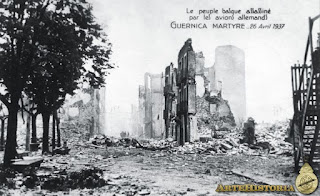
Día de la Paz, El Guernica

https://profeanacob.wordpress.com/2016/01/24/por-que-el-guernica-es-un-simbolo-de-paz/

Material para trabajar en clase el Día de la Paz, CEIP Ntra. Sra. de Guadalupe de Miajadas. Dirigido al alumnado de3er ciclo de Educación Primaria.

http://escueladepazcolegiosanjuan.blogspot.com.es/2016/01/el-guernica-de-la-paz.html

Un poco de Historia


El Guernica es el cuadro más famoso de Picasso. Se ha convertido en un símbolo, en un grito contra la barbarie y el horror de las guerras. Ha tenido y tiene diversas interpretaciones.
El pabellón de España de la Exposición Universal de París de 1937 se convierte en un grito de auxilio del gobierno de España de la II  ante el avance de los militares golpistas, la barbarie de la Guerra Civil y la pasividad de las democracias europeas. Para ello se movilizaron los nombres más reconocibles de la cultura española de la época, entre los que se encontraban Pablo Picasso, Miró (el mural El Segador, obra desaparecida) o Julio González (La Montserrat). El gobierno encarga al pintor, afincado en Francia, un cuadro de grandes dimensiones para que presida el pabellón español de la Exposición Universal de París de 1937.
El Guernica tiene un fuerte valor histórico y de denuncia; se pinta en plena Guerra Civil.  Pocos días antes de iniciar el cuadro, la aviación alemana que apoyaba a Franco bombardeó el pueblo de Guernica (Vizcaya). Este grave hecho afectó enormemente a Picasso y le indujo a titular así el cuadro.
Debido al estallido de la Segunda Guerra Mundial, el artista decidió que la pintura quedara bajo la custodia del Museum of Modern Art de Nueva York hasta que finalizara el conflicto bélico. En 1958 Picasso renovó el préstamo del cuadro al MOMA por tiempo indefinido, hasta que se restablecieran las libertades democráticas en España, regresando la obra finalmente a nuestro país en el año 1981. Desde 1992 el lienzo está colgado en una de las salas del Museo Reina Sofía de Madrid. Cumpliendo con el deseo del artista, la obra  vino a España una vez instaurada la democracia.

Datos técnicos y artísticos

Picasso antes de iniciar el cuadro hizo numerosos bocetos preparatorios sin alusiones al bombardeo. Son un alegato contra la barbarie de las guerras.

El lienzo tiene unas dimensiones considerables (3,50 x 7,80). Lo pinta con la técnica del  óleo en blanco, negro y variaciones de grises, como símbolo de luto, para acentuar el dramatismo.
Es de estilo cubista (estilo que descompone las imágenes reales y las representa en un mismo plano de forma geométrica), expresionista y simbólico. La composición se organiza en triángulos, destacando el central. Y en dos grupos de figuras representadas: seres humanos (soldado herido, varias mujeres y niño muerto) y animales (toro, caballo y paloma). La línea está claramente definida.


miércoles, 16 de noviembre de 2016

Proyecto e-Twinning: Bird's Eye View into Our Classrooms

Over the course of the next few months we will share particular lessons that the students really enjoy in our classrooms. I would like to focus on Drama, Art & Sport. 


domingo, 9 de octubre de 2016

UNIT 1: ECOSYSTEMS- 4th grade (II)


Food chains and food webs

One of the most important relationships between living things in an ecosystem involves energy. Every organism needs energy in order to live. Energy moves through an ecosystem through food chains and food webs. All food chains begin with energy from the SUN.

Food chain is the feeding relationships from one organism to another in an ecosystem.

Food chain has different levels:

·         Producer.
·         Herbivores (primary consumers).
·         Carnivores (secondary consumers).
·         Decomposers.

http://studyjams.scholastic.com/studyjams/jams/science/ecosystems/food-chains.htm


http://studyjams.scholastic.com/studyjams/jams/science/ecosystems/food-webs.htm